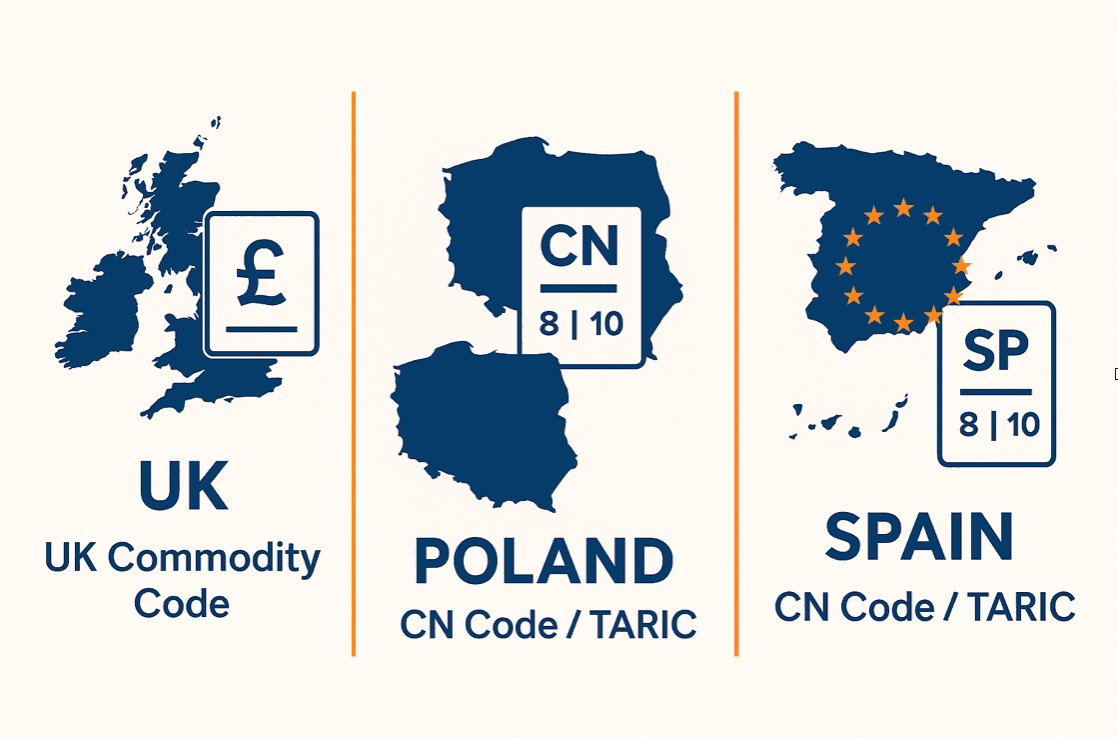
1. The UK: Commodity codes & the UK Global Tariff
In the UK, importers/exporters must use commodity codes via the official “Trade Tariff” service. theddcgroup.com+3GOV.UK+3uktrade.github.io+3
Key points for the UK:
The UK’s classification uses the HS-6 digits as the basis, and then adds further digits for national differentiation. Wise+1
The UK Global Tariff (UKGT) applies from 1 January 2021 for goods entering the UK from outside its preferential trade-arrangements. API Catalogue+1
The UK goods classification is divided into 21 sections (shown in Roman numerals) in the tariff tool. uktrade.github.io+1
Failure to classify correctly may lead to paying wrong duty, missing licensing requirements or delays. Scanlon Freight
Example risk: If you import a product described vaguely (e.g., “electronic accessory”) but classify under a generic HS code, you might face higher duty or need a licence that you didn’t anticipate. Using the UK Trade Tariff service ensures you find the correct code. GOV.UK+1
2. Poland: EU Customs Union, CN & TARIC based system
Since Poland is a member of the EU customs union, its goods classification falls under the EU’s system (i.e., the Combined Nomenclature (CN) and the Integrated Tariff of the European Communities (TARIC)). Trade.gov+2Taxation and Customs Union+2
Key points for Poland (and other EU Members):
The CN uses an 8-digit code structure: six digits from HS + two digits for EU subdivision. Taxation and Customs Union+1
TARIC codes go further (10 digits or more) and integrate EU measures (tariff quotas, suspensions, duty offsets) for each product/entry. Agencia Tributaria+1
Since Poland applies the EU’s Common Customs Tariff (CCT) for non-EU imports, duty rates are consistent across the EU external border. Trade.gov+1
Internal EU trade (goods circulating between EU member states) is often duty-free, but classification still matters for statistical, regulatory, VAT and internal movement purposes. icetransport.com+1
Example risk: If a UK exporter wants to send goods into Poland (or vice versa), though the duty may be zero (for EU internal movement), they still need the correct CN/TARIC code for the customs documentation. If they treat it like UK classification, they may mis-declare the code and face cost/time issues.
3. Spain: EU classification + Spain-specific customs procedures
Spain, as another EU member state, uses the CN/TARIC system for classification of goods. Agencia Tributaria+1
Key points for Spain:
Import duty rates from non-EU countries into Spain are determined via the TARIC system, accessible through the Spanish customs agency. Agencia Tributaria+1
For many industrial goods the duty is relatively low (e.g., 0-5% average). Trade.gov+1
Goods from outside the EU also attract Spain’s VAT (21% standard), with reduced rates (10% or 4%) for certain categories. blog.consultinghouse.eu+1
Example risk: If you export from the UK into Spain post-Brexit and treat it as internal EU movement mistakenly, you may overlook duty or VAT obligations or have the wrong classification under Spanish/TARIC rules, leading to delays or additional cost.
4. Key Differences & What They Mean for You
Here are some of the major differences and what exporters/importers should bear in mind:
Take-away points:
Always start classification using the HS-6 digits (the global baseline) then verify the national/EU specifics (UK commodity code vs CN/TARIC). Trade.gov+1
Use the country-specific tariff/commodity code lookup tools:
UK: Trade Tariff tool. GOV.UK+1
Poland/EU: TARIC / CN database. Taxation and Customs Union+1
Spain/EU: TARIC + Spanish customs site. Agencia Tributaria+1
Checking code accuracy is vital: wrong code can mean wrong duty, missing licences, wrong statistical reporting, or even export/import refusals.
Even within the EU (Poland/Spain), classification matters for internal movement, VAT, excise, quotas and preferential origin.
5. How Trade Link Helps You Navigate Classification
At Trade Link, we specialise in cross-border trade between Spain, Poland and the UK — and classification is one of the major areas where we support our clients:
We assist with selecting the right HS/commodity code for UK exports and imports, ensuring you use the correct UK classification.
We guide you through the use of the CN/TARIC system for goods entering or moving within the EU (Poland & Spain), so you’re compliant with EU/Spanish/Polish rules.
We monitor duty/quotas/licensing changes and help you apply for preferential tariffs where applicable (e.g., UK trade agreements).
We integrate classification checks into our transport & customs clearance process so that your goods aren’t delayed due to coding errors.
We offer training and templates so your internal team can classify goods (or check third-party declarations) with confidence.
6. Final Thoughts
Classification might seem technical or “just a code” — but in practice it’s foundational to international trade compliance and efficiency. Whether you’re shipping from the UK to Poland or Spain, or receiving goods from across these markets, getting your classification right keeps your supply chain smooth, your costs predictable and your business protected.
If you’d like a full assessment of your product classification (UK/Spain/Poland) or need help setting up your internal classification processes — let’s talk. Trade Link is here to simplify the complex so you can focus on growing your business across borders.
Trade Link — Connecting Markets. Moving Opportunities. 📩 Contact us for a classification check today
Need Expert Guidance?
Get help navigating UK customs systems with CDS integration, GVMS setup, and compliance support.
Contact Us